


From the haunting intimacy of Carmilla to the dangerous seduction of Dracula, and into today’s unapologetic dark romance, these stories reveal far more than monsters — they expose evolving attitudes toward female and queer desire. Daniela Koulikov traces how literature, monsters and fiction have given women permission to question, resist and ultimately claim their sexuality.
Monstrous Love. How literature reflects society’s understanding of women’s desires.
Throughout history, women have been expected to be quiet, gentle, loving caretakers.
Unless a woman was married, sex and desire were not meant to enter the equation; and if you were married, then you would probably be expected to submit to your husband at his pleasure.
If this was not where your desires lay, where would you turn to for escape? Many women went to books.
Over the centuries, literature has provided a space for women to explore their desires and challenge traditional gender norms. Contemporary dark romance novels, such as Haunting Adeline (2021) by H. D. Carlton and Butcher and Blackbird (2023) by Brynne Weaver, delve openly into sexuality and gender roles, expanding on the groundwork laid by gothic literature.
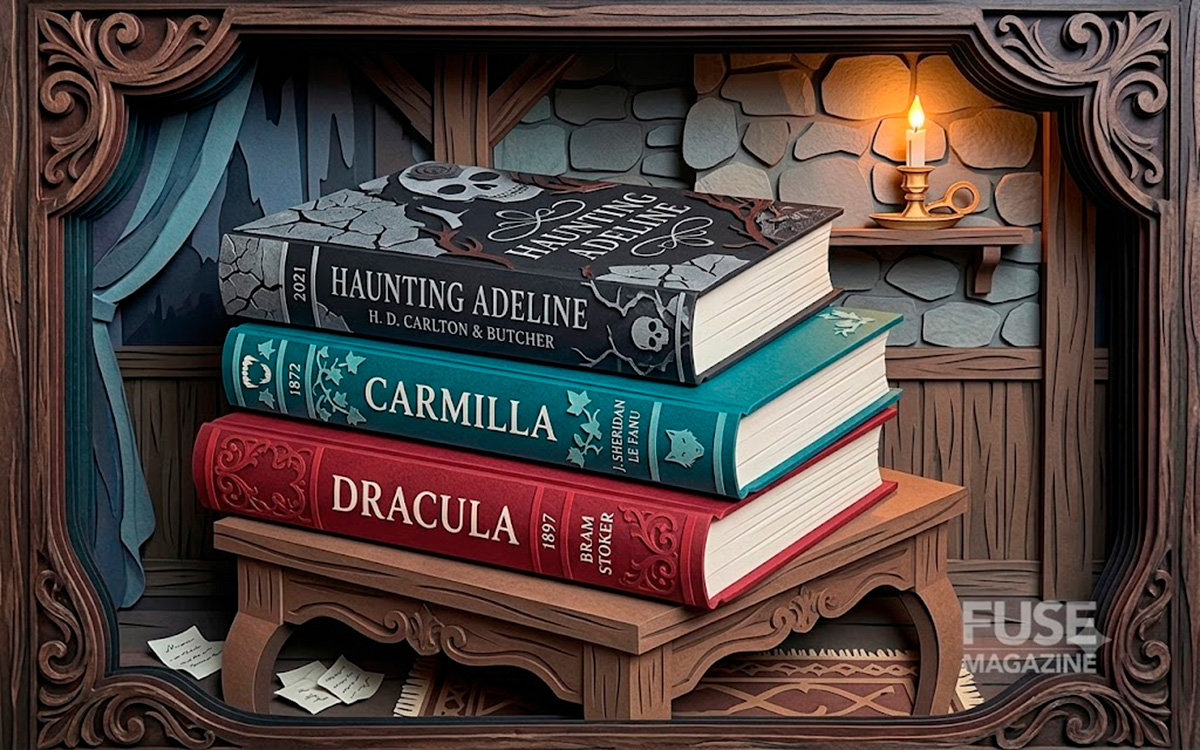
Earlier works like Carmilla (1872) by J. Sheridan Le Fanu and Dracula (1897) by Bram Stoker — considered scandalous and subversive — explored desire, romance and taboo in ways that were unsettling and terrifying at the time. They opened the gates for conversations about female desire and, more broadly, female liberation.
These novels are some of my personal favourites and you might be surprised to learn about their sapphic gothic roots.
Join me as we explore 150 years of literature that has allowed women to escape, question, desire and embrace their sexuality.
Carmilla and the realisation of desire
In 1872, the ideal woman followed a rigid, suffocating standard. She was expected to be an “angel in the house” — submissive, charming and devoid of sexual agency. If a woman felt otherwise, she might be diagnosed with hysteria or moral insanity.
Despite the UK Married Women’s Property Act passed in 1870, women were still largely considered the legal property of the men in their lives, namely their fathers and husbands. It was also difficult for a woman to leave a marriage.
The Divorce and Matrimonial Causes Act 1857 had changed the landscape by allowing divorce to be a matter for civil courts, and therefore reducing the price and making it more accessible for women. Yet divorce proceedings still favoured men. They only had to prove adultery, whereas women had to prove additional grounds, including cruelty.
It was in this environment, where the idea of women having autonomy brought deep social anxiety, that the novel Carmilla by Irish author Joseph Sheridan Le Fanu was released in 1871.
The novel explicitly explores the link between vampires and female desire, particularly women’s desire for each other.
The story follows a lonely young woman, Laura, and the fascination between her and the beautiful and seductive Carmilla. As they grow closer, Laura experiences an inexplicable illness, through which she uncovers Carmilla’s secret: Carmilla is a vampire. The relationship between the two women can be interpreted as an allegory for lesbian desire, and the terror of unregulated female sexuality.
For more than a century, women have turned to literature to explore the desires society told them to suppress.
What is most frightening about Carmilla is what she represents. She is not just a vampire, but rather a representation of how female desire grows when it is unrestricted by male authority.
In an environment where women were expected to be pliant and gentle, Carmilla is neither. She is both masculine and feminine. She is beautiful and soft.
“She used to fold me in her arms... and her lips would softly touch my cheek, and her breath was like the perfume of a garden.” (Carmilla, Chapter 4)
Carmilla was also possessive and dangerous.
“You are mine; you shall be mine; you and I are one forever.” (Carmilla, Chapter 4)
In 1872, a woman without a male guardian was a threat to the social hierarchy. Carmilla predominantly travels alone and lives for her own satisfaction. Laura’s feelings for her equally challenge gender norms. Not only does she desire Carmilla, but she also feels repulsion for the vampire.
If the vampire is an allegory for female desire, then Laura’s fascination represents her true feelings, while her repulsion is a result of internalised societal shame.
“I was conscious of a love growing into adoration, and also of an abhorrence. This mixture of sensations perplexed me. But the magnetism of the monster’s gaze was too powerful for me; I lived in her, and she was the one object of my existence.” (Carmilla, Chapter 4)
“Her hand lay on mine... and its touch, I can’t describe how, sent a thrill through me... I was at once fascinated and repelled.” (Carmilla, Chapter 4)
As the novel continues, it becomes clear that Laura’s illness is sexual in nature, and she can only be cured once the source of the illness has been eliminated. Even though Laura and Carmilla explore their relationship, their desires for each other are complicated and overall deadly.
The novel ends with the death of Carmilla, at the hands of men who are barely present throughout the narrative. Although Le Fanu had created a space for women to validate their desire, he ended the book by reinforcing traditional gender norms. Male authority corrects the disruption that female desire has created.
Dracula and the punishment of desire
Dracula is a gothic tale about a young English lawyer who travels to Transylvania to meet a new client, Count Dracula. The Count is an ancient vampire who then travels by ship to London and attacks Jonathan’s fiancée, Mina, and her friend, Lucy Westenra. The count feeds on them and the story concludes with Jonathan and his friends saving Mina before she transforms into a vampire.
Women in Dracula can be divided into two categories, commonly considered the virgin/whore dichotomy. In the 1890s, the “New Woman” was a feminist social movement, where women challenged gender expectations through seeking independence, suffrage, and sexual autonomy. The anxiety of the way society would be impacted through acceptance of the “New Woman” appears clearly in the novel.
Mina Harker represents the virtuous, subservient woman. She adopts the tools of the “New Woman”, as her intelligence and agency is noted; however, she stays loyal to patriarchal values and uses those tools to ultimately serve men. Lucy Westenra represents a hypersexualised woman, who has broken free from social constructs and embraced her female desire, the “New Woman” gone wrong. Lucy transforms from a virtuous young woman, intent on marriage, into an aggressive, hyper-sensual vampire.
“The sweetness was turned to adamantine, heartless cruelty, and the purity to voluptuous wantonness.” (Dracula, Chapter 16)
Although both are bitten by the count, Mina is saved by her fiancé; whereas Lucy is violently killed, with a wooden stake driven through her heart by her fiancé. This is described as returning her to her rightful state.
“There, in the coffin lay no longer the foul Thing that we had so dreaded... but Lucy as we had seen her in her life, with her face of unequalled sweetness and purity.” (Dracula, Chapter 16)
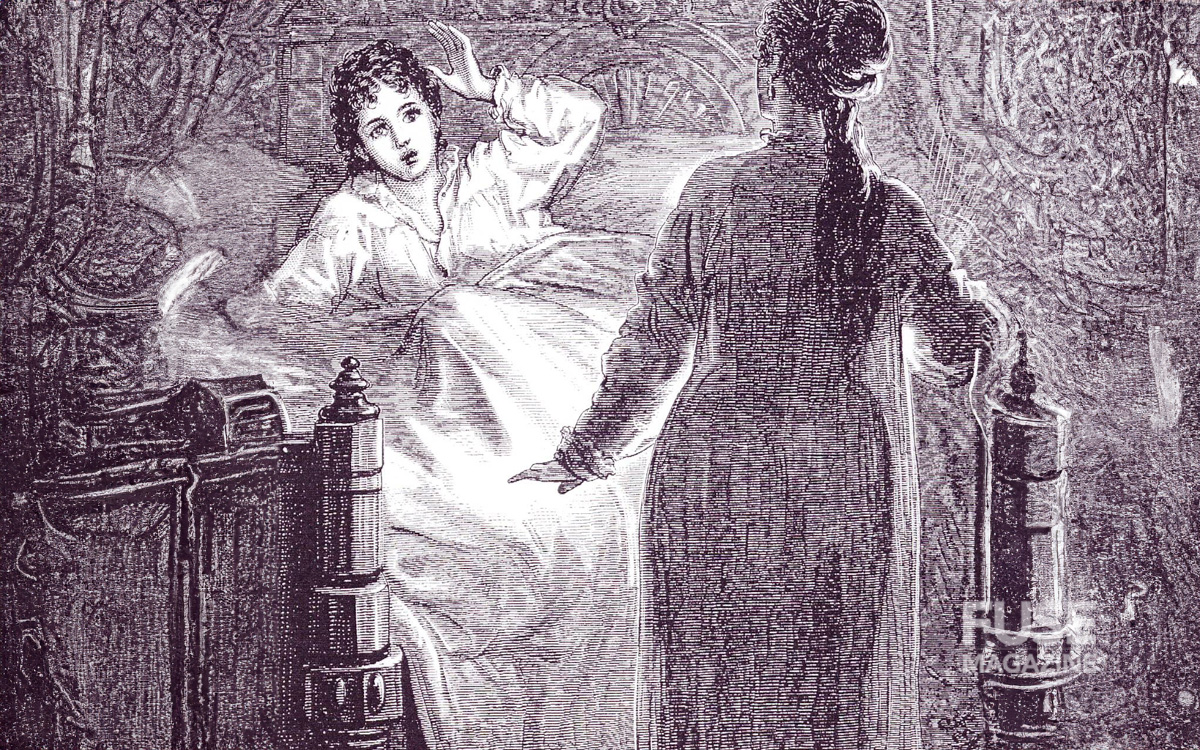
Illustration by David Henry Friston for Carmilla, 1872.
Lucy reflects societal anxieties about women’s sexual agency. A sexual woman was viewed as a perversion, and her death reinstates the perceived natural order. As in Carmilla, female desire must be eliminated for society to remain stable. Female sexual agency should be constrained, and if left unregulated, will cause terror. At the end of both novels, even though women experience and explore desire, male ownership continues to preside.
Modern dark romance and acceptance of desire
In the 1800s, the “monster” was a cautionary tale, and women’s desire was a disease that would easily spread if not regulated. These days, desire is no longer an illness or death sentence, but rather a normal aspect of everyday life. The monster itself has undergone a significant shift. While Le Fanu and Stoker used the supernatural veil of the vampire to represent the intrusion of sin into a pure woman, modern dark romance has removed the supernatural. The monster is now a human being that has transgressed and leaned into monstrous traits and actions.
Books like Haunting Adeline build upon the stalking themes found in Dracula, and allow Adeline, the protagonist, to understand her own desires instead of relying on a male collective to save and define her. Books like Butcher and Blackbird take it a step further, by allowing the woman to be equally monstrous without a need for purity or taming.
The role of men in these novels has also evolved. In Victorian texts, men often functioned as saviours and agents of control. In modern dark romance, they act as enablers, propelling the heroines to accept desires they previously felt uncomfortable exploring. While the Victorian monsters held a mirror to women, showing them a forbidden glimpse of desire, modern equivalents, such as Rowan in Butcher and Blackbird, encourage reflection and embracing of these desires. Rowan explicitly rejects the ‘pure’ version of Sloane, stating:
“I didn’t fall for the woman you pretend to be. I fell for the one who leaves bodies in her wake.” (Butcher and Blackbird, Chapter 22)
He doesn’t look to dissemble her desires, as it is the foundation of their intimacy.
Society’s understanding and openness to female desire has changed immensely over the last century and a half. Purity culture still exists in our society. It may be more subtle and go under a different name, such as the tradwife movement; however, legislatively, women have greater freedom and autonomy than we used to. Women are encouraged to explore their desires on an individual level and consider what suits them. Society does not demand the removal of women experiencing desire, as it is not largely considered a threat to society at large.
Even today, women still turn to books as a tool to navigate the space between empowerment and expectation, and literature continues to reflect and explore our understandings of ourselves and how we fit into society. We no longer need to crush out women’s desires. We can let them live.


