

When I first got my period, I thought I was going to die. Every now and then, I forget that I have it, and the same thought flashes through my mind. Is this it? When I started thinking about how I could live a more sustainable and eco-friendlier lifestyle, one of my biggest monthly inconveniences came to mind: my period. Tampons and pads fill my medicine cabinet. I spoke to a friend about it, and she mentioned re-usable period undies.
“I love them!” She told me.
“Are they safe to use…?” I asked her.
“Oh, yeah. They’re great. Especially overnight.”
I asked her a million questions: don’t they leak, are they hygienic, how do you wash them? She laughed and told me to look it up.
I did, and that’s what led us here.
The Issue with Single Use Plastics
Plastic bottles and wrapping stands out as a recycling issue, but I’d never thought that period products could be a contributor to landfill.
It turns out that every single year in Australia, we buy an estimated 300 million tampons and 500 million disposable pads. Globally, that feeds into a staggering 45 billion period products discarded annually.
Because a conventional disposable pad is made of up to 90% plastic, it will take approximately 500 years to break down.
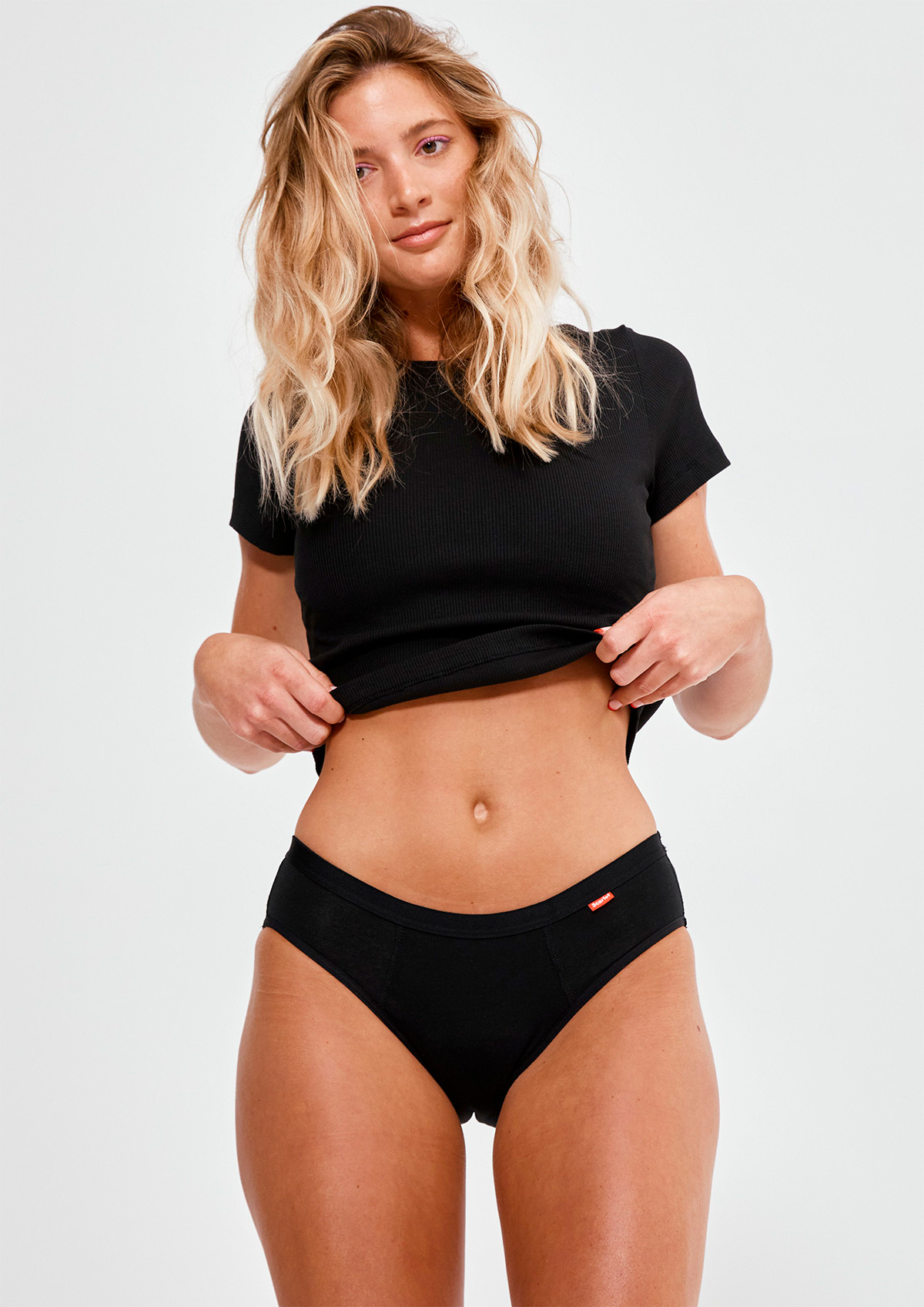
Period Bikini Brief. Light to moderate. Easy daily coverage. Period underwear that looks like normal underwear. Because it should. Soft 95% organic cotton with a leak-proof lining underneath. Choose light (around two tampons' worth) or moderate (around three). PFAS-free and lab tested. The kind of pair you forget you're wearing.
So, What’s Available?
After learning about how conventional pads and tampons contributed to landfill, I went to look up the ingredients of the products I’d been using. I was surprised to find out that in Australia, companies are not legally required to disclose the ingredients on their tampon or pad packaging. This is because the Therapeutic Goods Administration (TGA) classifies them as medical devices rather than consumer goods.
That being said, there are brands that voluntarily disclose their materials. Australian brand TOM Organics, for example, launched the world’s first organic cotton tampons back in 2009 and are transparent about their operating practices. That made me feel better: if a friend is coming over and needs to use a disposable period product while they’re at my place, I picked up a few organic disposables for them.
I was ready to look at other options, though, beyond disposables. There were two main options on the market: menstrual cups and period underwear.
- Menstrual Cups: While the very first menstrual cup was patented all the way back in 1932, the modern, medical-grade silicone models we use today didn't hit the market until 2002.
- Period Underwear: A 2016 study by CHOICE confirmed that both menstrual cups and period underwear have a drastically lower environmental footprint over their lifecycles compared to traditional pads and tampons, making them the gold standard for a sustainable cycle.
Test Running Period Undies
I reached out to Scarlet Period and they provided me with a few pairs of period briefs to test out. Scarlet stood out to me for a few reasons. They’re designed in Melbourne, and independently owned, founded by Jo Barry, who’s passionate about making periods better. All their products are PFAS-free and they’re a 1% for the Planet member, meaning they’ve committed to donating at least 1% of annual sales (not just profit) directly to approved, vetted environmental nonprofits. They’re also body-inclusive and diverse with their models. That was enough to sway me.
Using it firsthand gave me the answers to the questions I started with.
- Will they leak? This was my biggest fear, but mine didn't leak at all, even on my heaviest days.
- Are they hygienic? They felt just as clean and fresh as using a standard pad or tampon. For the wash routine, I placed them in a dedicated mesh laundry bag before throwing them into a regular cold cycle.
- Are they easy to wear? Definitely. They’re less bulky than a regular pad and I comfortably wore them beneath my jeans.
- Would I recommend them? Without hesitation.
The Cost of Period Undies
The main barrier for most people will be the upfront cost, as buying a full cycle's supply requires an initial investment. While the ACT government doesn't currently offer a financial subsidy, several local councils across Australia now run dedicated rebate programs that subsidise the cost of reusable sanitary products to help residents make the switch.
Check out this article to see whether your council may offer a rebate program.
So frequently, when we look at sustainable options, we need to consider accessibility.
To understand the structural and social reality of this issue, I looked at the data from Share the Dignity's monumental Bloody Big Survey, which captured the lived experiences of over 153,000 Australians.

The Affordability Crisis
Driven by recent inflation and the broader cost-of-living crunch, reproductive hygiene has become a primary financial pain point. 64% of Australian menstruators have found it difficult to afford period products at some point in their lives. In regional and remote Australian communities, supply chain limits worsen the blow, pushing the cost of a single pack of basic pads up to an extortionate $15 to $25.
The "Survival Improv"
When the grocery budget falls short, Australians are forced into dangerous, highly unhygienic trade-offs:
- 1 in 5 Australians (and 25% of all TAFE and university students) have been forced to improvise on period products because of financial distress.
- People routinely resort to using socks, toilet paper, rags, or even rolled-up newspapers to manage their cycles.
- Close to 30% of respondents admitted to wearing a pad or tampon for longer than the safe 4-hour limit simply to stretch out their supply, directly risking severe bacterial infections and Toxic Shock Syndrome (TSS).
The Equity Gap
The data shows that period poverty doesn't impact everyone equally. It disproportionately isolates vulnerable and marginalized groups, creating a severe barrier to education and employment:
Period poverty is most prevalent in Tasmania and least in the ACT. That may be due to ACT becoming the first jurisdiction in Australia to pass and implement the Period Products and Facilities (Access) Act, legally mandating free access to period products, in late 2023.
This was done by rolling out discrete, free dispensers across public libraries, community health centres, and over 30 ACT public schools.

What’s Next?
It can be hard to care about sustainability when you’re experiencing period pain. The biggest thing that stuck with me during my research is that sustainability isn’t about being perfect: it’s about doing your best.
For me, the path forward is clear: I’m officially sticking with period underwear as my go-to choice and keeping a stash of organic disposables on hand for those inevitable "tight spot" moments.


