


Ancient terminology
The term “lesbian” had a different meaning in ancient Rome. It referred to people who lived on the Greek island of Lesbos. One famous inhabitant was the poet Sappho, who wrote about her love affairs with women (and men).
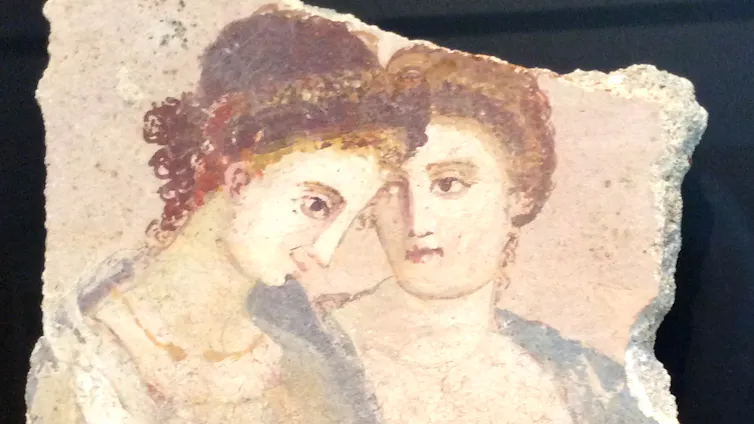
The tribas is a satiric caricature that only appears in a handful of Roman texts, including the poet Martial’s Epigrams. Despite its infrequency, however, the figure offers compelling insight into ancient Rome’s gender and sexual norms, and the women who challenged them.
How Romans responded to cultural change
Roman men dealt with big governmental changes during the early stages of the empire. For centuries, power had been held by a small number of elite oligarchs. But in 27 BCE, it was handed over to one man: the first emperor, Augustus.
During this transition, and as the empire expanded, foreign cultures became more embedded in Roman society. Roman satirists often used women and foreign cultures as scapegoats to account for moral decline in society.
For example, in the 1st century CE, satirical poet Juvenal described women as devious, licentious adulterers. Satirists attributed all kinds of depravities and disturbances to women, although this seldom had any basis in reality.
Women were also the frequent target of crude jokes in satire. The tribas is one such example.

A Roman ‘lesbian’?
The tribas figure only appears in some surviving low-brow, satirical Roman texts from the 1st century CE. There are no known visual representations.
This literary caricature generally mocked women who pursued sexual relationships with women as “failed men”.
The tribas figure is said to carouse and aggressively penetrate women in an attempt to copy men’s behaviour. It’s certainly not a positive (or accurate) representation of lesbians.
Rather, it’s an exaggerated portrayal of ancient Roman women who rejected patriarchal norms – and who likely chose women as lovers.
The term tribas comes from the ancient Greek tríbō, meaning “to rub” or “wear down”. The Romans emphasised the Greek origin of the term to culturally disassociate the tribas from “normative” sexual practices of their society.

Sex and power in ancient Rome
Power and sex went hand-in-hand in ancient Rome. The ideal Roman man was, according to convention, politically, socially and sexually “active”. A uir (male citizen) consolidated his authority by sexually subjugating a “passive” woman or adolescent male.
The tribas figure was meant to amuse male audiences, as she supposedly fails to “properly” perform the male sexual role.
Be that as it may, the caricature still knowingly usurps male prerogatives. Really, then, the tribas symbolically challenges the meaning and stability of Roman masculinity.
The Roman poet Martial’s depiction of a woman named Philaenis (unintentionally) demonstrates this. He writes of an unhinged and rather remarkable tribas:
The tribas Philaenis
satisfies eleven girls a day
with a hard-on more raging than a man’s
she plays handball […] and easily lifts
weights considered heavy for studs.
Philaenis exhibits better physical endurance than Roman men. The “humour” for the male reader lies in the tribas being so excessive. In Roman culture, any form of physical or emotional excess was associated with unrestrained and unmanly behaviour.
On the other hand, it’s also implied that women might prefer Philaenis as a lover to a man.
The translation of the poem above uses the phrase “hard-on” for the Roman tentigo, a term often attributed to a male erection. But as Philaenis is a woman, it’s possible it is used here disparagingly to refer to an olisbos (dildo).
In a culture so deeply entrenched in phallic supremacy, Romans couldn’t fathom sexual acts that didn’t involve penetration, or a phallus.
That said, it’s not clear whether Philaenis is actually using an olisbos, so this tribas’ portrayal remains open to interpretation.

The tribas through a Butlerian lens
Rather than simply casting Philaenis as a “failed man”, there’s another way to look at her actions. The theory of performativity, coined by feminist philosopher Judith Butler, provides a good framework for analysing the behaviours of this tribas.
By continually engaging in “manly” activities, Philaenis reveals that masculinity is performative. And this implies Roman men were compelled to repeatedly perform male gendered behaviours to maintain their dominant status.
Philaenis therefore shows masculinity was not exclusive to Roman men; she bends the “rules” of Roman male culture to suit her own agenda.
Recent scholarship has likened the masculine-centred identity of the tribas to the modern butch lesbian identity. While this is certainly a noteworthy comparison, it’s worth remembering that the butch identity is a modern concept. The ancient world had different ways of perceiving gender and sexuality.
So did women like Philaenis really exist? Well, Martial had to get his inspiration from somewhere. While we can’t confirm it, the tribas suggests there were women in ancient Roman society who didn’t live by heteronormative codes.
Claire Ferguson, Associate Lecturer in Classics, University of Tasmania. This article is republished from The Conversation under a Creative Commons license.


